

 Facebook
 X
X
 Pinterest
 Copy Link
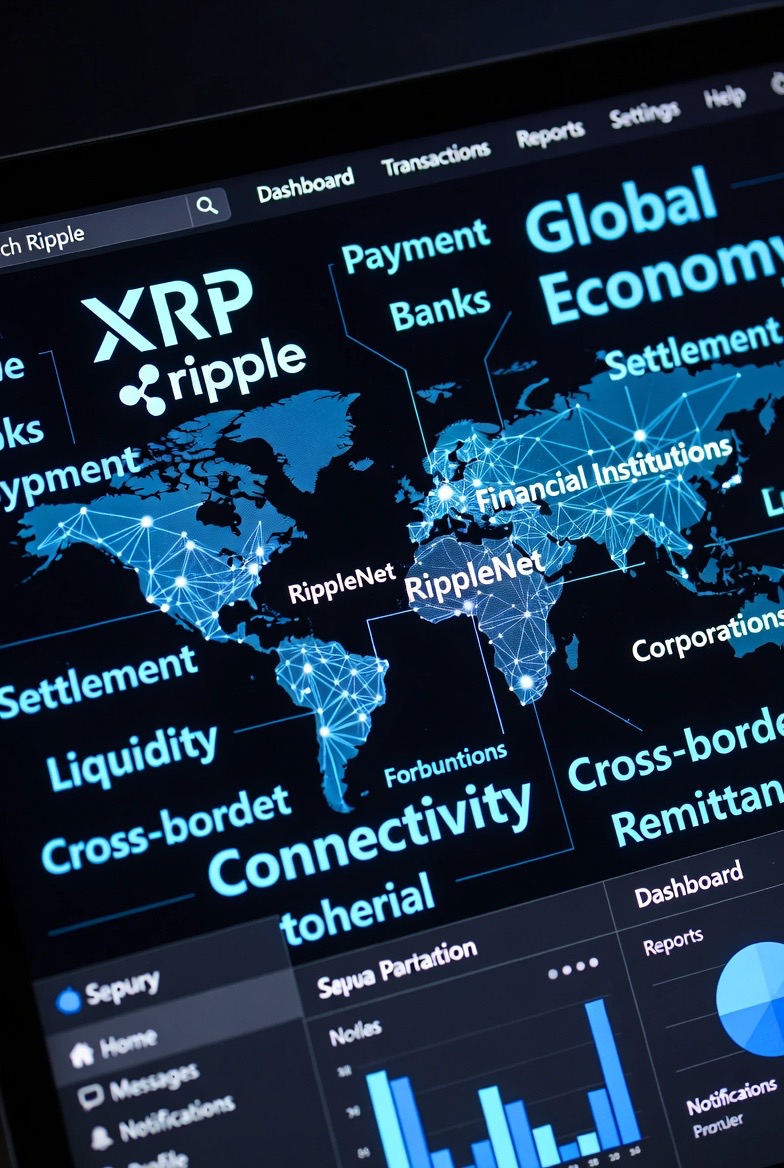
Are We on the Brink of a Liquidity Crisis — and How Will Real Estate and Life Change?
The Puzzle Pieces Align: XRP as the Backbone of the Coming Financial Order
by Mark Lanfranchi · September 2026
You can feel it in daily life even if the headlines still call it “resilient.” Credit is tighter. Refinances stall. Commercial loans hit the wall. Dealers hoard balance sheets. Gold and silver keep getting bid while paper claims pile up. That is a liquidity squeeze — too much debt chasing too little cash — and it is the pressure that forces a reset of the rails underneath money itself.
The thesis of this piece is simple: the old Federal Reserve note system is mathematically exhausted, a return to Treasury-issued, asset-backed money is the only durable exit, and the XRP Ledger — with Stellar as a sister high-speed rail — is already being plumbed into the institutions that move the world’s value. Settlement in 3–5 seconds is not a slogan. It is the utility that a frozen, leveraged system will need when paper promises stop clearing.
The Squeeze We Are Living Through
The U.S. Treasury is rolling staggering sums of debt every week. Bank reserves have been yo-yoed by bill issuance and the Treasury General Account. Repo and equity-financing rates have diverged in ways that make quarter-ends dangerous. Analysts at major houses have warned that a deleveraging event is no longer a fringe scenario.
Households feel it first in real estate. Commercial mortgage-backed securities are slamming into a maturity wall measured in tens of billions. Distress and delinquency have ticked higher. Madison’s real-estate liquidity index reversed after two years of improvement. Thirty-year yields have printed levels not seen in a generation, crushing property spreads. Office and some multifamily owners cannot refinance without writing a check. Private-credit funds have faced redemption waves. That is not a soft landing. That is collateral being repriced because cash is scarce.
When cash is scarce, settlement speed stops being a crypto talking point and becomes infrastructure. Days-long T+ settlement and correspondent banking are liabilities. Instant finality is oxygen.
The Debt Clock and the Treasury Dividend Dollar
Visit usdebtclock.org. Beneath the official debt ticker sits a long-running argument: currency should be issued by the Treasury, not a private central bank, and it should be backed by real value — gold, silver, and productive assets — instead of an ever-growing IOU. Call it the Treasury Dividend Dollar: a system that pays citizens from the nation’s real wealth rather than taxing them to service a cartel’s interest.
Interest on the federal debt is now in the trillion-dollar neighborhood. Unfunded liabilities dwarf the headline number. A debt note inflated toward pennies on the original dollar cannot be the backbone of a free people. The logical endpoint is a return of the money power to the Treasury and a hard-asset standard — not another round of paper.
Legal Rails: EOs 13848 and 13818, Devolution, COG
Executive Orders 13848 (foreign interference) and 13818 (corruption and human-rights abuse) remain on the books. In this reading, they are not dusty proclamations. They are the legal hooks for freezing and seizing the assets of actors who looted the system — across finance, justice, and every branch of government.
Layer that with Continuity of Government planning and what many call devolution: a controlled transfer of authority away from compromised institutions and back toward constitutional Treasury power. Traitors do not get to keep the printing press. That is the political half of the puzzle. The technical half is a neutral ledger that can settle the new money and the old claims without asking permission from the same cartel.
1988 Roots and 3–5 Second Utility
Distributed, tamper-evident timestamping and consensus ideas were patented and published well before Bitcoin — work stretching from the late 1970s into the late 1980s. The XRP Ledger, live since 2012, is the institutional expression of that lineage: no proof-of-work energy tax, no proof-of-stake cartel of stakers, just deterministic consensus and finality in three to five seconds at sub-penny cost.
Bitcoin is too slow and too volatile for wholesale settlement. Ethereum is gas-volatile and probabilistic. Solana still carries outage risk. XRP was built for corridors. Ripple’s On-Demand Liquidity already moves real bank volume across dozens of countries. Ripple has sat in ISO 20022 and BIS rooms for years. SWIFT’s own shift onto ISO 20022 only makes those corridors more relevant.
In June 2026, JPMorgan, Mastercard, Ondo, and Ripple completed a tokenized U.S. Treasury redemption on the XRP Ledger. Traditional rails take three to five business days. The test cleared in about five seconds. That is the product.
XRP and Stellar: Two Fast Rails, One Job
Jed McCaleb left Ripple and built Stellar. In my view they split to cover more ground, not to cancel each other. Both settle in seconds. Both are now treated as interoperable pieces of the same institutional puzzle.
The DTCC — the utility that sits under nearly every U.S. stock and bond trade and safeguards about $114 trillion — is running a multi-chain tokenization program. Limited production was slated for July 2026, with a wider fall expansion. Ripple Prime sits inside the DTCC industry working group with names like BlackRock and JPMorgan, shaping workflows, custody, and collateral movement. Stellar was named a public-chain issuance venue for tokenized Russell 1000 names, major ETFs, and Treasuries, with broader connections targeted for 2027.
Stellar has pulled ahead on raw tokenized-asset dollars — several billion on-chain, including Treasuries and money-market funds from houses such as Franklin Templeton and Ondo. XRPL’s RWA stack is smaller in headline TVL but is growing through RLUSD, Aviva’s tokenized liquidity share class, Ondo paper, Archax, Société Générale, and a custody-to-issuance pipeline Ripple is assembling with firms such as Komainu, ZILO, Licuido, and SettleMint. Boston Consulting Group’s long-run RWA figure — tens of trillions by the 2030s — is the prize both rails are aiming at.
XRP remains the asset with the clearest U.S. legal posture after years of court fights: treated as a commodity in secondary markets, with CFTC and SEC contours that most utility-free tokens still lack. Chains that cannot settle, cannot comply with ISO 20022-era messaging, and cannot survive a courtroom will not be invited into DTCC-grade plumbing.
Tokenizing Life: Credit, Property, Gold, Silver
The XRP Ledger was designed for issued assets: compliance hooks, clawbacks, native DEX and AMM, and incoming vault and lending amendments (XLS-65 / XLS-66) so credit itself can live on-chain. Real estate fractionalization, supply-chain finance, gold and silver tokens, and instant credit draws all need a bridge that does not seize up when volume explodes.
COMEX coverage ratios in silver have spent 2026 in stress territory — paper claims many times registered metal. Vault flows, lease-rate spikes, and delivery notices keep reminding the market that physical is not infinite. Exchange rules for congested contracts allow alternative settlement mechanics. When paper-to-physical breaks, the revaluation will need a digital layer that can clear explosive volume without a holiday. That is the “589” conversation the XRP community has carried for years: a symmetric revaluation of hard assets into a Treasury-backed system.
What Changes for Real Estate — and for Ordinary Life
Agents do not disappear. Trusted, authentic ones become more valuable, not less. When titles, liens, escrow, and fractional ownership move on-chain, the job shifts from paper-chasing to verification, local knowledge, and fiduciary care. People locked out of upgrades by rate shock and debt will move again if and when restitution and a sound unit of account arrive — call it abundance instead of a lifetime mortgage to a debased note.
A reset that ends the Fed-note monopoly, the IRS as collection arm of perpetual war finance, and the habit of being born into someone else’s interest book is not a small story. It is dark if you follow the rabbit hole of who captured the money power. It is also simple if you keep the principle: money backed by real value—gold, silver, land, productive enterprise—not a debt coupon worn down to three cents on the original dollar.
When does the switch flip? No honest writer knows the hour. What we can see is the plumbing: DTCC tokenization windows in 2026–27, tokenized Treasuries already testing five-second finality, RWA balances climbing on both XRPL and Stellar, metals markets straining at paper ratios, and a household liquidity squeeze that is no longer theoretical.
The Pieces Interlock
Debt collapse forces a Treasury-issued, dividend-bearing, asset-backed dollar. Executive orders and continuity protocols are the legal broom. Decades-old decentralized ledger design shows up as 3–5 second settlement. Ripple and Stellar cover adjacent ground and now touch the same DTCC table. Gold, silver, property, and credit want a rail that does not crash. Escrow and supply discipline on XRP tighten just as institutional demand shows up.
When the switch is flipped, XRP is not waiting in the hallway. It is already seated — with Stellar beside it — at the center of the table. The puzzle is nearly complete. Everything else without real utility, legal clarity, or ISO-era compliance is noise.
— Mark Lanfranchi
Note: This is commentary and analysis, not investment, legal, or tax advice. Tokenization pilots, court outcomes, and executive orders are public facts; interpretations of devolution, restitution, and a Treasury Dividend Dollar are the author’s.
