

 Facebook
 X
X
 Pinterest
 Copy Link
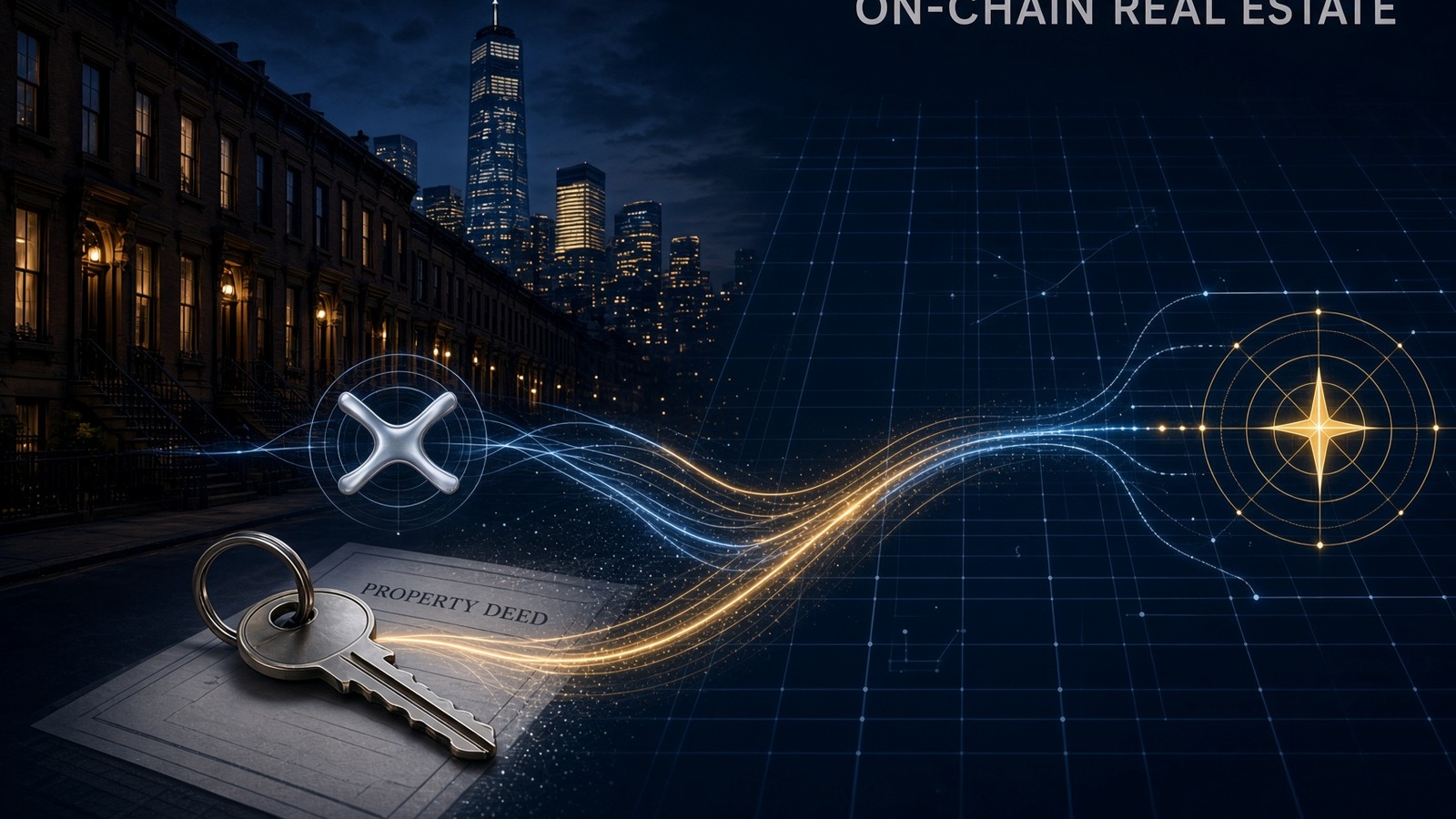
Tokenization does not replace the house. It replaces the wait.
Finance still charges you for waiting. A house can be agreed upon in an afternoon and take weeks to close. A Treasury, a gold bar, or a stock can be agreed upon in a second and take a business day to settle. That delay is the product: extra hands, extra ledgers, idle cash.
Tokenization is the fix. Put a legal claim on a real asset — a property, a Treasury, a bar of gold — on a ledger that runs 24 hours a day. Pair it with on-chain dollars. Settle both sides at once. The building does not change. The wait does.
Why this matters on Staten Island and in Brooklyn
I sell buildings, not tokens. Title, survey, taxes, and the closing table still decide whether a deal lives. What is changing is the plumbing beneath those deals. Real estate is a real-world asset. Treasuries, gold, funds, and commodities are already represented on-chain. Property is next because it is the same problem: a valuable claim trapped in a slow system.
When that claim can move after Friday’s close, the broker who already knows the block, the title quirks, and the buyer still matters. The rails change. The house does not.
What tokenization actually does
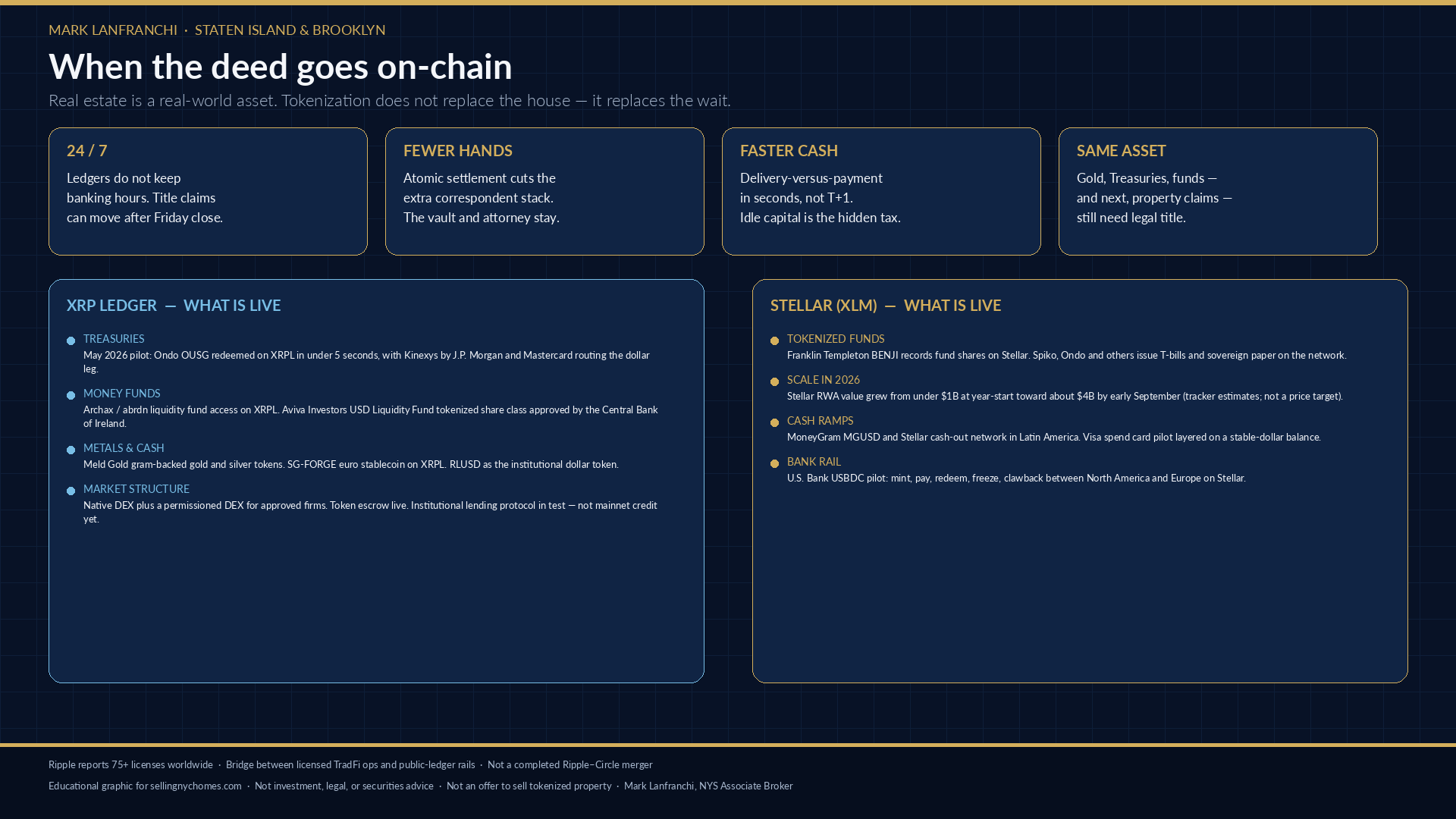
A token is not the house. It is a digital representation of a legal claim on an off-chain asset. Once the asset and the cash are on a ledger, settlement can be atomic: delivery versus payment, with both legs or neither. Markets no longer keep banking hours. The extra correspondent stack gets compressed. The vault, the custodian, and the closing attorney remain, because someone still has to prove the asset is real.
Cheap and fast are the same feature. Speed is what happens when you stop paying people to wait.
What is already live on the XRP Ledger
This is not a white paper. In May 2026, Ondo Finance, Kinexys by J.P. Morgan, Mastercard, and Ripple completed a near-real-time, cross-border redemption of a tokenized U.S. Treasury fund. The token leg settled on the XRP Ledger in under five seconds. The dollar leg moved through bank rails outside normal hours.
Regulated money funds are on the same ledger. Archax, the FCA-regulated UK exchange and custodian, put access to an abrdn dollar liquidity fund on XRPL. In July 2026, Aviva Investors launched a Central Bank of Ireland–approved tokenized share class of its USD Liquidity Fund, with BNY Mellon still holding the underlying assets.
Metals and cash are there too. Meld Gold issued gram-backed gold and silver tokens on XRPL. Société Générale’s SG-FORGE deployed its euro stablecoin on the ledger. Ripple’s RLUSD is the institutional dollar token sitting alongside those assets.
Market structure is being built in public. XRPL has a native decentralized exchange and a permissioned DEX for approved firms. Token escrow is live. An institutional lending protocol is in test — that is not the same as live mainnet credit. Say it that way.
What is already live on Stellar (XLM)?
Stellar’s strength is low-cost issuance and payments. Franklin Templeton’s BENJI fund records share ownership on Stellar. Other issuers have brought T-bills and sovereign paper onto the network. Tracker estimates put tokenized real-world assets on Stellar at under $1 billion at the start of 2026, growing toward about $4 billion by early September. That is a size estimate, not a price target.
The cash ramp is real. MoneyGram extended its Stellar work, launched MGUSD, and is rolling out a stable-dollar balance with cash-out through its agent network in Latin America, plus a Visa spend card pilot. U.S. Bank ran a USBDC pilot on Stellar between North America and Europe—mint, pay, redeem, freeze, clawback—within the bank’s own risk stack.
Ripple’s actual edge
Ripple is not the only network touching both traditional finance and on-chain markets. What Ripple is: a company that already operates within the existing system — with more than 75 regulatory licenses worldwide, including full MiCA authorization in Europe — while the XRP Ledger beneath it runs settlement, a DEX, permissioned venues, and incoming credit tools.
What this is not
It is not a magic listing. It is not a substitute for a title search, a survey, or a closing attorney. It is not an offer to sell tokenized Staten Island or Brooklyn property. Tokenized real estate will still sit on a street with taxes, tenants, and a certificate of occupancy. When the rails show up at the closing table, you still need someone who knows the building.
The 24/7 point
Gold, silver, oil, other metals, commodities, stocks, Treasuries, bonds, and — in time — property claims can all be a token plus a legal wrapper. Once the cash leg is a regulated dollar token, the trade does not need a Monday morning window. Settlement gets cheaper because fewer firms touch it. It gets faster because software finishes what clerks used to chase. It runs Saturday night because the ledger does not close.
The assets were always real. The delay was the fiction.
Disclaimer —
Educational content only. Not investment, legal, tax, or securities advice. Not an offer to sell tokenized property or any digital asset. Past pilots and license counts do not predict price or the timing of New York residential title settlement on-chain. Mark Lanfranchi is a New York State Associate Real Estate Broker with Coldwell Banker Advantage, serving Staten Island and Brooklyn. License 10301220599. sellingnychomes.com · 917-613-3923
